
Lampasas County Sex Offender Checks
The Texas Public Sex Offender Registry is the main access point for Lampasas County registry searches. Texas Department of Public Safety operates it at no charge under Code of Criminal Procedure Chapter 62. It gathers public registration data reported through local registration authorities across the state. That statewide role matters because Lampasas County does not publish a separate county registry database or local map in the official sources reviewed.
Choose the search route that matches the question. A name search is useful when a person is already known, while an area search is suited to neighborhood awareness. The institution mode offers a distinct route tied to higher education. Spelling, aliases, and recent updates can affect results. For a concern about local registration or suspected noncompliance, contact the Lampasas County Sheriff rather than trying to resolve it from a screen.
The DPS registry search screen shows the official entry point used for these checks.
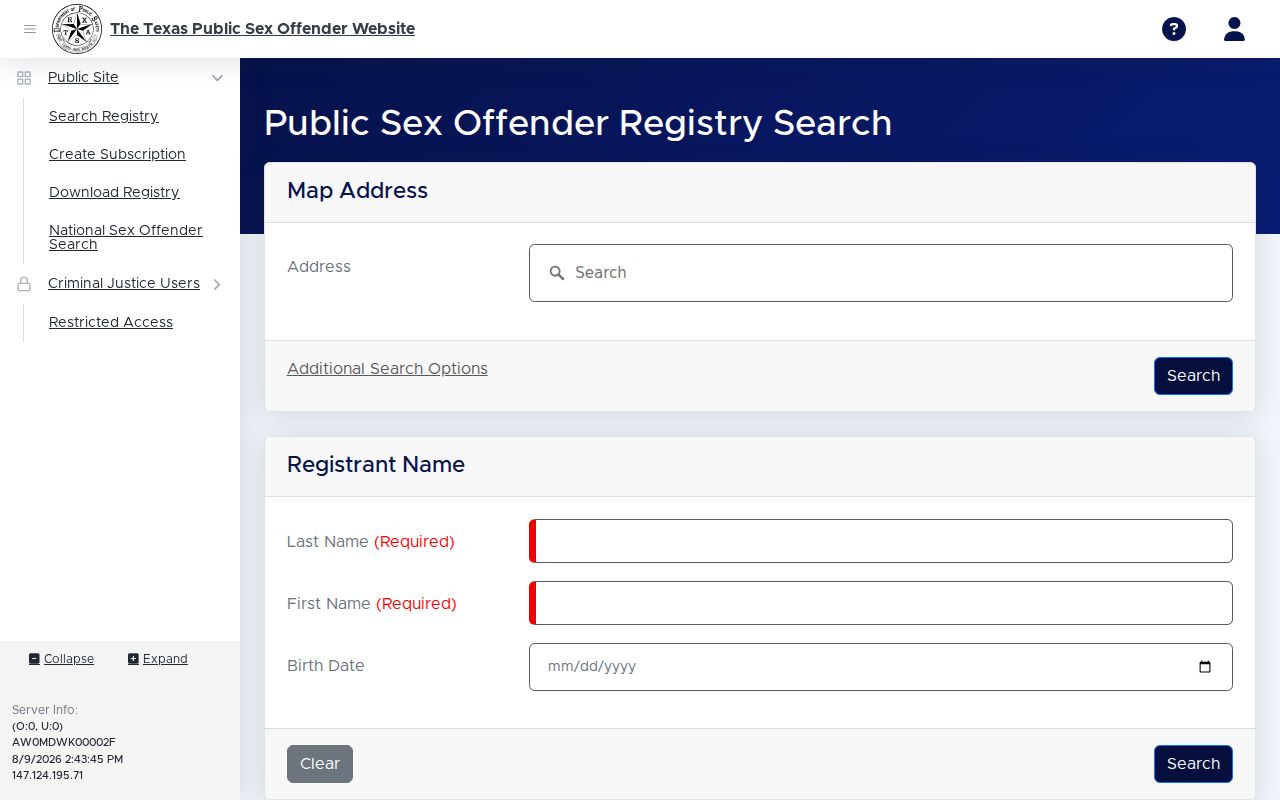
Its separate search modes help a reader begin with the identifier or place that best fits the safety question.
Texas Public Sex Offender Registry Searches
DPS presents three search modes: Name, Area, and Institution of Higher Education. The live system did not reliably expose exact required fields, radius choices, or dropdown values during research, so those controls should be read as the portal displays them at the time of use. Do not assume a fixed distance or selection that is not shown.
- Open the official DPS registry and review its conditions for lawful public-safety use.
- Select Name, Area, or Institution of Higher Education based on the information already known.
- Enter only the fields the current form requests, then run the search and compare aliases, location, and descriptors.
- Open the matching profile, read its status and offense details, and confirm any concern with DPS or the Lampasas County Sheriff.
The table records only controls verified in Lampasas County research. It avoids adding a radius value or required-field claim that the live portal did not confirm.
| Field or Mode | Type | Required | Use |
|---|---|---|---|
| Name search | Tab and form | Mode-dependent | Search by a known name; spelling and aliases matter |
| Area search | Tab and form | Mode-dependent | Use address, city, ZIP, or county geography as offered |
| Institution of Higher Education | Tab and form | Mode-dependent | Run an institution-oriented search |
| Search and Reset | Buttons | Not applicable | Execute or clear the query |
| Results, map, and download | Controls | Unspecified | Live options vary; DPS also publishes downloadable data |
Lampasas County Offender Search Boundaries
The Texas portal is the best source for the state profile, but a state line can narrow what one search reveals. The U.S. Department of Justice National Sex Offender Public Website searches participating jurisdictions and is useful when a safety question crosses state borders. NSOPW supplements the Texas registry. It does not replace the details maintained in the Texas profile or the local authority’s role.
Start with DPS for a Lampasas County address, status, and Texas registration detail. Use NSOPW when the person or location may connect to another state. If the two displays seem different, compare update dates and identifying details, then ask the agency that owns the record. A broad result is not proof that two similar names belong to the same person.
The official NSOPW search interface illustrates the national layer available to Lampasas County residents.
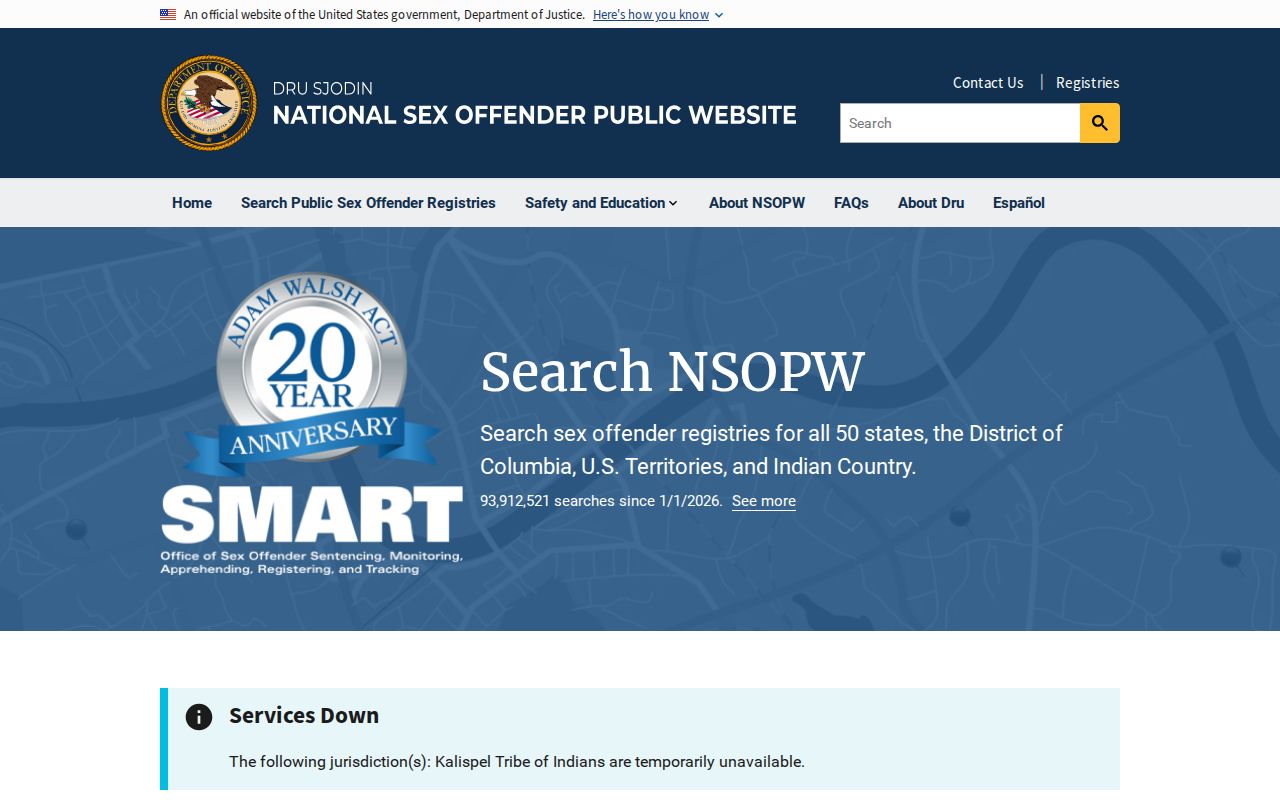
Its value is geographic reach, while the Texas profile remains the primary source for Texas registration details.
Registry Profiles: What They Show
A Texas registry profile combines identity descriptors, a current public image, location, reportable-offense facts, and registration status. It should be read as a structured agency record. Matching a name alone is weak. Compare aliases, date of birth, physical traits, photograph, and residence before reaching a conclusion.
Article 62.005 makes most central registry information public but excludes sensitive fields. Public output does not include Social Security numbers, driver-license numbers, home or work phone numbers, cell numbers, online identifiers, employer details, victim-identifying information, other protected DPS data, or juvenile information made nonpublic by a court.
| Name and Aliases | Reported legal name and alternate names used to distinguish the registrant. |
|---|---|
| Photo and Description | Recent color photograph plus sex, race, height, weight, eye color, and hair color. |
| Residence | The public registered residence information maintained through the reporting process. |
| Offense | Reportable offense and the date of conviction or adjudication. |
| Risk and Status | Numeric risk, registration status, and verification information shown by DPS. |
| Other Public Fields | Education-institution data and, for specified trafficking offenses, listed vehicle information. |
Correcting Lampasas County Registry Concerns
A location that looks wrong should be treated as a verification issue, not an invitation to confront anyone. Save the public profile URL or the details needed to identify the entry. Note the address or status that appears inconsistent. Then contact the Lampasas County Sheriff for a local registration concern or DPS when the issue concerns the statewide display.
Describe the discrepancy without circulating protected personal claims. The agency can compare the report with its own records and decide whether investigation or a data update is warranted. Call 911 only when there is an immediate emergency. Suspected failure to comply with registration is a law-enforcement matter, and Texas prosecutes that failure as a felony.
Note: A public profile may lag a recent agency report, so give the responsible office enough detail to locate the exact entry.
Registration Levels and Duties in Texas
Texas uses Level 1, Level 2, and Level 3 as public risk labels, but the label does not decide how long a person must register. The reportable offense and Article 62.101 control duration. This is also different from treating the Texas labels as federal SORNA tier numbers.
Verification timing follows a separate rule. A civilly committed person generally verifies every 30 days. A person with two or more sexually violent offenses generally verifies every 90 days. Others generally verify once each year. The table keeps risk, duration, and check-in timing distinct so a Lampasas County registry result is not reduced to one number.
| Category | Meaning or Duration | Verification |
|---|---|---|
| Level 1 | Low danger or low likelihood of continued sexual offending; offense controls duration | Usually annual unless another rule applies |
| Level 2 | Moderate danger or possible continued offending; offense controls duration | Usually annual unless another rule applies |
| Level 3 | High danger or expected serious continuing danger; offense controls duration | Usually annual unless another rule applies |
| Civil commitment | Separate sexually violent predator process and registration rules | Generally every 30 days |
| Lifetime category | Offenses and circumstances listed in Article 62.101(a) | Depends on verification category |
| Other adult category | Generally 10 years after release, discharge, or supervision ends | Depends on verification category |
| Juvenile duty | Generally 10 years after disposition or completion, subject to court action | Depends on governing order and law |
Lampasas County Registry Notifications
Public access and active community notice are not the same process. Texas may use bilingual postcards when a high-risk or civilly committed registrant moves into a qualifying area. The statewide program page explains the registry and public-notification framework, while the DPS search supplies the public profiles used for routine awareness.
The Texas Sex Offender Registration Program page shows how DPS frames registration and public notice.
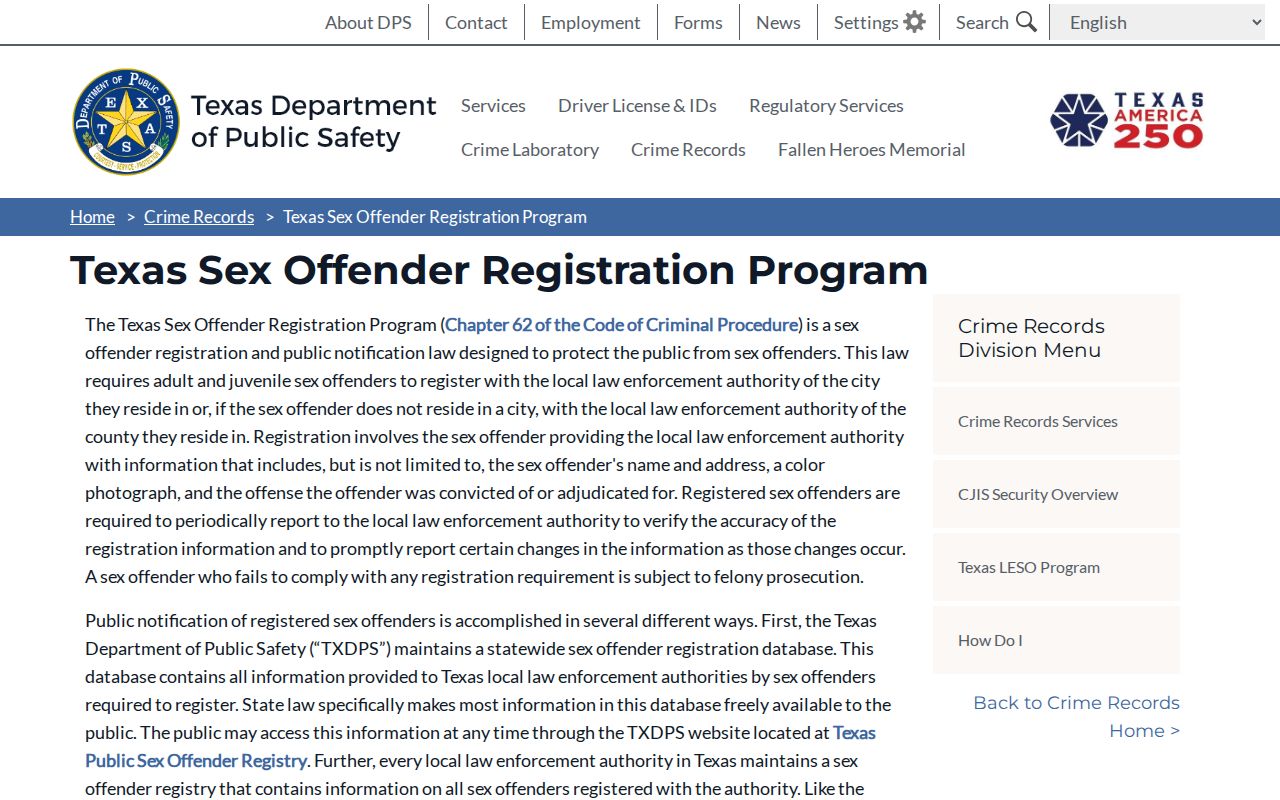
The program view adds context that a single Lampasas County profile cannot provide, including the state’s role and the legal basis for public access.
Chapter 62 does not impose one universal statewide residence distance. A city may have authority to adopt child-safety-zone rules. Check the current Lampasas ordinance before relying on a claimed distance. A registry map alone does not prove which local rule applies at a specific parcel.
Lampasas County Registration Timelines
“Ten years or lifetime” is a better starting distinction than guessing from risk level. Article 62.101(a) defines lifetime categories based on listed offenses and circumstances. Article 62.101(b) generally sets a ten-year period for other adult statutory categories after release, discharge, or the end of supervision. Juvenile duties generally run ten years after disposition or completion, subject to court modification.
The start point matters. A ten-year duty is not always measured from the conviction date shown near the offense. Release from confinement, discharge, or completion of supervision can control. If the end date is unclear, the profile should not be used to calculate one independently. Ask the registration authority or DPS to explain the status shown.
Note: Texas risk labels describe assessed danger, while Article 62.101 and the underlying offense determine the registration period.
Using Registry Information Lawfully
Registry information exists for personal, family, and community safety. It can support awareness of a listed residence, careful reading of a reportable offense, and a call to the proper agency when information appears inconsistent. It does not authorize a resident to punish, follow, threaten, or expose a listed person or household.
Texas Code of Criminal Procedure Chapter 62 governs registration and public access. High-risk and civil-commitment moves may lead to the state’s bilingual postcard process. The Lampasas County Sheriff is the local contact for noncompliance questions, while DPS maintains the public portal.
Registry misuse warning: Misusing registry information to threaten, intimidate, or harass is an offense under Texas Code of Criminal Procedure Article 62.005. Report a concern to law enforcement instead of confronting anyone.